

Mediation is a process which is designed to help the parties reach an agreement, but on their own terms. It offers numerous advantages over other forms of dispute resolution (like going to court or continuing with lengthy legal battles), including that it saves time and money, and reduces stress.
When might mediation be appropriate?
When it seems like there is no solution to a conflict, or that “going to court” is the only way forward, mediation can provide a simple, affordable, welcome solution. It is so much better to reach a mutually satisfactory settlement.

Mediation is a structured, fair and clear way to help people (including groups of people) to reach agreement or resolution on key issues. It’s a way of stepping back and taking a fresh look at the problem. It is a semi-formal process which is nothing like going to court.
The parties agree to take part but are not forced to agree anything they don’t want to. The mediator helps them to identify issues, develop or explore options for resolving those issues, work through the implications of each option and – if the parties agree – negotiate an agreement which will actually work. It is the parties that make all decisions, not the mediator.
Conflict often seems unavoidable when people are “stuck” in set positions. There are often underlying issues which are not immediately clear. Mediation offers the parties a way to navigate their positions and issues, ensure that they are heard, understand each other and the bigger picture better, and find a resolution together. It often brings additional perspective and understanding between the parties which can change things completely, and in many cases good communication can even be restored ongoing.
The mediation process very often enables people to reach an amicable resolution to issues which previously were thought to be “unresolvable”. Various studies have shown that mediation resolves issues in around 80% of cases, and those which don’t can go on to resolve in the days after the mediation process ends.
The process?
When you appoint me as your mediator, there’s a simple process we’ll step through. Here it is outlined in headline terms:
- Appointment by the parties. This is where you both (all) agree to take a mediation approach. There is some paperwork to do, and then I’m appointed as mediator.
- Induction meetings. I hold private and confidential meetings with each party to start gathering information and to understand your preferences for the day. Our discussions are not shared with anyone else.
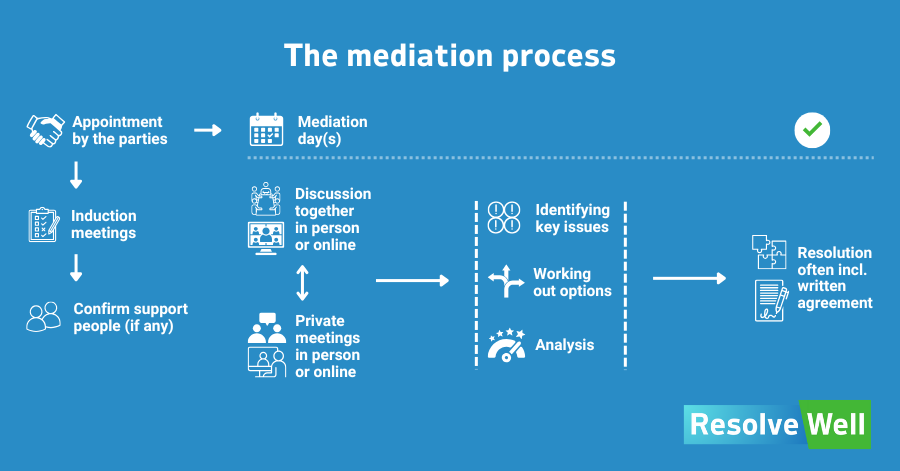
- Mediation day. We all gather on an agreed day in an agreed place (including possibly online). Most of what takes place from this point is in a room together. But sometimes we need to break out into private meetings.
- All mediations are private between the parties and information remains confidential.
- There is a clear agreement to mediate and a very clear process to follow.
- There is no compulsion to agree – in other words, the parties will only reach agreement if everyone wants to do that.
- You can have a support person or advocate (including lawyer) with you. We’ll discuss this at the induction meeting.
- Tell your story. Each party (including you) gets to share their story and why they are at mediation. We all take time to listen carefully to what each party has to say. As mediator, I’ll ask questions and reflect back what I’ve heard. The purpose of this part of the process is to ensure that everyone has their say, and that everyone is heard.
- Identify issues. Together, we identify the key issues to be discussed and resolved. This is important as it sets the direction for the rest of the day.
- Identify options. Together, we work through various options to resolve these issues. Ultimately, the parties come up with all the options – so you are in complete control.
- Evaluate options for resolution. This is where the rubber hits the road: I help you work together to identify for yourselves which of the options for resolution will work for each of you, and see where we can find common ground.
- Resolution/conclusion. At the end of the mediation, we record where the parties have got to and, wherever possible, we’ll pull together an agreement. If everybody is comfortable, you may decide to finalise the agreement there and then. Once this has been achieved and recorded, my involvement is over.
- Note that any agreements you ultimately make are legally binding on all parties, which gives you clarity, certainty and the ability to move on!
Costs and timeframes
Compared to other ways of solving disputes (like going to court, arbitration or other forms of adjudication), mediation is relatively swift and cost effective.
Most mediations can be completed in a full day of meetings, and can be scheduled within a few weeks of agreeing to mediate. Some are even swifter. Complex mediations (involving complex commercial issues or multiple parties) can take longer.
I will work through this with you once you brief me on your requirements. I will also be able to discuss costs with you. I have a clear pricing structure based around the nature and complexity of the dispute, how much work I’ll be required to do in advance, how many parties are involved and how long the mediation is likely to take. The mediation costs will be clear, up-front and reasonable.
Questions, next steps and getting started
- Contact Mark here
- Is the dispute, disagreement or set of issues you are facing well suited to mediation? Find out here.
- Read more about mediation here and more about facilitation here.
- More detail about Mark’s background here.